Live radio: click the speaker icon to start or stop, and use the slider to set the volume.
Dutch Top 2000 facts – Top2000feitjes website
Settings
Settings explained
Theme: The Jumping Fox
By default the site uses the Neon theme (purple, pink and cyan). On: the brown theme of The Jumping Fox. Separate from Party mode.
Countdown
The countdown clock to the next Top 2000, off by default. The clock only appears with the live radio, not with the live picture. Off: the clock disappears, the rest of the block stays.
Ticker
The scrolling line of facts on the home page. Off: the line disappears.
Equalizer
The moving bars next to the little speaker while the radio is playing.
Colour player
In full screen the LP spins in colour (black). Off: the transparent gold version. While Party mode is on, this stays on.
Party mode
Full screen only, off by default. On: laser lights and balloons for a song in the top 10, and the full show for number 1.
Smart reconnect
If the stream drops, the player tries to reconnect by itself (up to 10 times). Off: you tap Listen live again yourself.
Your choices are remembered in this browser, on this device. “Reset all to default” puts everything back.
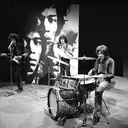
The weird bit: The chorus has a line about kissing the sky, but many listeners hear a line about kissing a guy instead. The rest of the lyrics are also a cryptic dream image.
According to Songfacts, Hendrix made the joke bigger himself by sometimes singing the line that way live and pointing at a band member (the latter is based on unofficial live recordings; there is no direct statement from him about the misunderstanding). Hendrix said the song came from a dream in which he walked underwater, lost in a purple haze, and was saved by his faith. He denied it was about drugs; many listeners still read it as an acid trip. A science fiction novel (Night of Light by Philip Jose Farmer) is mentioned as an inspiration, but that has only been suggested by readers on the site and is unconfirmed.
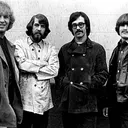
The weird bit: In the chorus, a great many people hear a line about a bathroom on the right-hand side instead of the ominous line about the moon. That clashes with the cheerful music behind an almost apocalyptic lyric.
John Fogerty knows about the misunderstanding and plays along with it himself: he sometimes sang the wrong version at concerts, and said (according to a 2025 iHeart report, citing a Forbes interview) that these days he points to the 'other right side' when fans hold up signs. About the real meaning, Fogerty said he was inspired by the film The Devil and Daniel Webster (1941), with a hurricane that destroys a village, and that it was about an approaching disaster.
unclear meaningbest position 1, in 2025 position 1
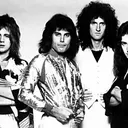
The weird bit: The lyrics are a six-minute opera full of strange names and words (Scaramouche, Galileo, Bismillah, Beelzebub) with no visible story. The band has never given an official explanation.
Freddie Mercury never explained it; he reportedly brushed it off to Kenny Everett as nonsense rhyme, and in 1986 told a biographer it was about relationships. Brian May refuses to say what it means because that spoils a song, and Roger Taylor said in Mojo that it is about a man who is executed for murder and repents but remains philosophical about it. Biographer Lesley-Ann Jones reads it as Mercury's coming out; that is her reading, not a confirmed statement from the band.
unclear meaningbest position 252, in 2025 position 450
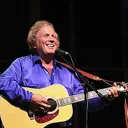
The weird bit: A long lyric full of symbols (the jester, the king, the quartet, the day the music died) where it was never clear who or what is meant.
The beginning is about the plane crash of 3 February 1959 in which Buddy Holly, Ritchie Valens and The Big Bopper died; after that the song widens into the loss of innocence in America up to around 1970. McLean refused to explain it for decades, but at the auction of the manuscript in 2015 he said it is 'basically' about things going the wrong way, and the catalogue confirmed that the song ends with the murder of Meredith Hunter at Altamont. In 2022 he said many of the figures are fictional: Presley is not 'the king' and Dylan not 'the jester'; that contradicts the 2015 catalogue text, and Dylan himself rejected the jester reading in 2017.
The weird bit: The chorus is very often heard as a line about the actor Tony Danza instead of the 'tiny dancer' from the title.
The misunderstanding is so well known that it was used in the sitcom Friends (1996): Phoebe sings the wrong version. Elton John and Bernie Taupin have not commented on it in the sources used. On who the song is about, the sources contradict each other: according to Elton it was about Taupin's girlfriend Maxine Feibelmann, but Taupin himself says it was about free-spirited women he met in clothing shops in Los Angeles in 1970.
unclear meaningbest position 3, in 2025 position 143
The weird bit: The lyrics jump between strange images, sixteen vestal virgins and a reference to Chaucer, without it being clear what is actually going on.
Lyricist Keith Reid says he does not understand why people find it unclear; he calls it a story, a journey, seen through a male character. The title came first: at a party Reid heard someone tell a woman she looked pale. He calls the reference to Chaucer a diversionary tactic; by his own account he has never read Chaucer. The author of the source used (Tim de Lisle) reads it as a seduction fuelled by drink; that reading is not the band's own.
The weird bit: A deliberately incoherent lyric with nursery rhymes, strange images and sounds like 'goo goo g'joob'.
According to Songfacts, Lennon wrote it partly to frustrate listeners who analysed every Beatles song, after he received a letter from a schoolboy whose teacher had his class dissect Beatles lyrics. The walrus comes from Lewis Carroll's poem; Lennon later said he only realised afterwards that the walrus is the villain in it and the carpenter the hero, so he had picked 'the wrong one'. Songfacts names Finnegans Wake as a source of the sounds and Pete Shotton as the supplier of a nursery rhyme; Lennon also said that in the lyrics he was partly aiming at Hare Krishna and Allen Ginsberg.
The weird bit: The lyrics contain a word, 'pompatus', that is in no dictionary and whose meaning nobody knew.
According to Wikipedia, Miller misheard the word from the song The Letter by The Medallions; singer Vernon Green had used an invented word there ('puppetutes', a made-up paper-doll figure). Straight Dope mentions that Green said the original words were 'puppetutes' and 'pizmotality', the second supposedly indicating secret words for the beloved. According to fans, Miller once said the word means nothing and is just jive talk, but Straight Dope could not confirm this.
The weird bit: The chorus has a word that many hear as 'douche', when it is actually about a famous type of car.
Springsteen's original had a line with 'deuce', a reference to the Deuce Coupe, a 1932 Ford hot rod. In the version by Manfred Mann's Earth Band, 'deuce' sounds like 'douche' because of a technical problem (a tape-head misalignment), and they could not fix it afterwards. According to Manfred Mann the confusion was an accident; Springsteen joked that the song only became a hit after Mann turned it into a song about a hygiene product. He wrote the original with a rhyming dictionary.
unclear meaningbest position 190, in 2025 position 684
The weird bit: The title says he would do anything for love 'but not that' - without it ever becoming clear in the chorus what 'that' is. People speculated about it for years.
According to an article in Louder (Dave Everley), the answer is in the verses: he refuses to leave her after sex and to forget her, and he refuses to cheat. Meat Loaf said people would work it out; lyricist Jim Steinman thought not and called the refusals a puzzle, with a chivalrous, Lancelot-like tone. The article itself calls the question a 'non-mystery'.
unclear meaningbest position 351, in 2025 position 351
The weird bit: The lyrics consist of dreamlike images, such as someone walking slowly down a corridor and yet going faster than a cannonball, with no clear story.
Noel Gallagher said in a SiriusXM interview (2020, for the 25th anniversary of Morning Glory) that he himself has no idea what the lines mean and that while playing on the last tour he drifted off and wondered what it was. About the cannonball line he said in so many words that he has no idea. His own conclusion: the song is 'nonsense', and the meaning lies in the fact that generations of teenagers sing along.
The weird bit: In the middle of an English-language song there is a French-language section, and the singer acts nervous and incoherent - odd for a song about a murderer.
David Byrne says he first saw the song as an Alice Cooper ballad in the style of Randy Newman. The French interlude is a cryptic confession by the murderer about an evening in the past. Byrne first asked a friend to write it (she declined), after which bassist Tina Weymouth, whose mother is French, wrote it in a little over an hour. According to the source article, the switch of language may also suggest a second personality (a kind of Norman Bates), or simply be a stylistic choice; which of the two is intended is not settled.
The weird bit: The title is a Russian-sounding word that in the song is a woman's alias.
Kate Bush said in 1980 (programme Countdown) that it is about a woman who tests her husband's faithfulness by writing to him under the alias Babooshka as a younger woman; he becomes fascinated and the relationship falls apart. By her own account she did not initially know that 'babushka' means 'grandmother' in Russian. For the story she cited the English folk ballad Sovay, about a woman who disguises herself as a highwayman to test her lover.
unclear meaningbest position 250, in 2025 position 836
The weird bit: The Netherlands has no mountains, so what is a song with 'Dutch Mountains' in the title actually about?
Henk Hofstede said in an EO article that the idea came from a map in his primary school in Amsterdam-Oost: Germany and Belgium were coloured white and he thought the mountains began just beyond the border. The song is about his childhood in Amsterdam (brick houses, the Weesper Trekvaart). According to him, the mountains stand for longing and the unknown, the feeling that you do not yet know where you are heading. So the mountains are a metaphor and not a description of the landscape.
hidden meaningbest position 125, in 2025 position 1346
The weird bit: A cheerful tune with a string of first names (Holly, Candy, Little Joe, Sugar Plum Fairy, Jackie) and descriptions where many listeners did not realise what was being sung.
Lou Reed said he took inspiration from Nelson Algren's novel A Walk on the Wild Side; when a planned musical based on it fell through, he replaced the characters with people from Andy Warhol's Factory. Holly is Holly Woodlawn and Candy is Candy Darling (both transgender actresses), Little Joe is based on Joe Dallesandro's role in the film Flesh, and Sugar Plum Fairy was Joe Campbell (the nickname was, according to Wikipedia, a euphemism for drug dealer). In 1972 RCA sent a censored version to radio stations without the line about oral sex, and 'colored girls' became 'the girls'.
unclear meaningbest position 637, in 2025 position 755
The weird bit: The lyrics are poetic and spiritual, with an invented mythical name (Oroladian) and images that do not form an everyday story.
Jon Anderson, who wrote it with Vangelis (for the album Friends of Mr. Cairo, 1981), told Songfacts in 2013 that the concept is the 'state of independence' that people grow towards. According to him, Oroladian is a mythical figure who opened the 'gate of memory', and the song refers to the poem On Passing the New Menin Gate by Siegfried Sassoon. He describes the lyrics as positive, about worldwide unity, meditation and truth; the message is that the truth will come. The choir on the Summer version was assembled by Quincy Jones.
unclear meaningbest position 382, in 2025 position 1856
The weird bit: The title is a strange way of telling the time: what does '25 or 6 to 4' mean? Drug stories arose around it.
Robert Lamm wrote the song, by his own account, late one night while living above the Sunset Strip: he looked at his watch and it was twenty-five or six minutes to four in the morning, while he was searching for a line for the chorus. The rumour that '6 to 4' is street slang for LSD (a tablet at six in the evening lasts until four) is described by the source article as a rumour, not as the origin of the song.
The weird bit: In the chorus an exclamation is sung that many hear as the name Bruce, but it is not an ordinary word.
Jeff Lynne says it was a gap in the vocals and that he just shouted whatever came to mind; he wanted to replace it but found nothing better. According to Lynne (in a VH1 appearance), engineer Reinhold Mack pointed out that it sounded like the German 'gruss' (greeting), and so it stayed. Mack tells it differently (Sound on Sound, 2013): the title was originally a joke with the name Bruce, because of a planned tour of Australia, and later it became a German greeting. The source article does not decide who is right.
The weird bit: A chorus that calls on everyone to get 'stoned', in a song with an odd title containing two numbers and a Salvation Army-style brass band.
Many listeners and Time magazine in 1966 read it as a drug song, and some stations banned it. Dylan said in 1966 that he has never written a drug song, and in 2012 told Mikal Gilmore that anyone who reads it that way does not know the Book of Acts. Biographer Clinton Heylin reads it as a deliberate play on words with Biblical stoning. The numbers 12 and 35 are not clearly explained by the sources; Heylin only points to a Bible verse (Proverbs 27:15) about a dripping roof and a quarrelsome wife.
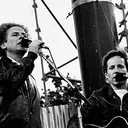
The weird bit: A song that asks where baseball hero Joe DiMaggio has gone, while he was not going anywhere at all.
Paul Simon said on the Dick Cavett Show that the name was there because of the number of syllables. When he later met DiMaggio, he said it was a tribute and that real heroes are rare; DiMaggio said he did not understand why he would be gone, since he was just doing commercials. The song also began as Mrs. Roosevelt, with placeholder sounds; Art Garfunkel said they tried every name with three syllables and 'Mrs. Robinson' was chosen because it suited the character in the film.
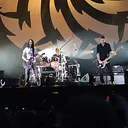
The weird bit: The title and the image of a black hole becoming a sun seem to make no sense; the song has a dreamlike, surreal lyric.
According to Songfacts, it started with Chris Cornell mishearing something a newsreader said; that mistake became the title. Cornell said he understood the song even less after it became a hit. The contrast between emptiness and the sun that makes life possible attracted him, but there was no intended theme; he mainly chose words that sounded good.
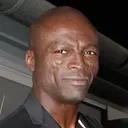
The weird bit: The chorus contains an image whose words are often heard as 'grave', when something else is meant, and Seal has never explained the meaning.
According to Songfacts, Seal has never explained the meaning and deliberately left the lyrics out of the album so that listeners can interpret them their own way. Keyboard player David Sancious says Seal told him that the word many hear as 'grave' is actually 'gray', a poetic choice that happens to resemble something else. Seal wrote the song around 1988 in a squat in London, before he had a record deal.
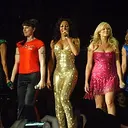
The weird bit: The chorus contains 'zig-a-zig-ah', a bit of nonsense that fans spent years wanting to decode.
According to Songfacts, Mel B said that 'everybody needs a zig-a-zig-ah and that it's what you want'; Mel C said it is slang for getting together with someone. Co-writer Richard Stannard says it was a nonsense phrase the group used while writing and that it is innocent; Songfacts writes that it comes from the group's private dictionary. So there is no fixed meaning; the group themselves say it can mean anything.
hidden meaningbest position 15, in 2025 position 125
The weird bit: The title sounds as if the song is about faith, but it is not.
According to Songfacts, 'losing my religion' is a variant on a Southern American expression and the song is not about religion but about losing faith in a person. Michael Stipe says the lyrics are about obsession and unrequited love: a shy lover who never voices his feelings. He said on Song Exploder that Every Breath You Take by The Police was a strong influence, and that he first wrote 'kitchen' instead of another place, which suddenly made it seem to be about himself.
hidden meaningbest position 25, in 2025 position 39
The weird bit: The title sounds like a slogan for a teenage revolution, but it turns out to be a deodorant brand, and the lyrics consist of contradictory images.
After a night of drinking, Kathleen Hanna of Bikini Kill wrote on Kurt Cobain's bedroom wall with a marker that he smelled like Teen Spirit; Tobi Vail, Cobain's girlfriend at the time, used that deodorant brand. Six months later Cobain phoned to say he wanted to use it. The source article states that Cobain did not know it was a deodorant, but gives no source for that. In 1994 Cobain told Rolling Stone that the lyrics mocked the idea of a revolution and consist of contradictory ideas.
The weird bit: The chorus sounds like a triumphant American anthem, while the verses are actually about a disillusioned Vietnam veteran.
According to the source article (Mental Floss), the song tells of a man from a struggling town who is sent to Vietnam, returns damaged and is forgotten by his country. The production, with its booming snare drum and big arrangement, makes it sound patriotic. Ronald Reagan mentioned Springsteen in August 1984 during a campaign visit in New Jersey. Springsteen called it a protest song in his memoir (2016) and wrote that listeners hear what they want to hear.
The weird bit: At the end Lennon mumbles a phrase that fans heard as a confession about burying Paul McCartney.
According to the source article (Far Out), Lennon said he said 'cranberry sauce' and that it had nothing to do with McCartney; in 1967 fans read it as confirmation of the rumour that McCartney had died in 1966 and been replaced. McCartney denied the rumour. The article's author thinks Lennon may have meant it deliberately as a dig at obsessive fans, but cannot prove it.
unclear meaningbest position 1, in 2025 position 3
The weird bit: The lyrics are a series of almost cinematic images (a hotel you can never leave) with no clear explanation, which led to all kinds of theories.
Don Henley said in 2007 that the song is about the excesses of American culture, about people the band knew and about the tension between art and commerce; on 60 Minutes he called it the dark side of the American dream, and in 2013 a journey from innocence to experience. Glenn Frey compared it to an episode of The Twilight Zone and said the listener builds a story from the images. Don Felder says Henley wrote much of the lyrics, including 'colitas', which he describes as a desert plant that blooms at night; the word is often read as slang for marijuana. Satanic theories come only from reader comments in the source used.
unclear meaningbest position 112, in 2025 position 160
The weird bit: The title seems to refer to the TV series The Twilight Zone, but the song tells a spy-like story.
According to Wikipedia, the title is not a reference to the TV series; guitarist George Kooymans wrote the song, inspired by the spy thriller The Bourne Identity. The video has a spy story in which Barry Hay plays an agent who is captured by three henchmen (the other band members).